Saturday, May 22, 2010
Clickers in Basic Reading/Writing Class
For the past couple semesters, I've used clickers aka Student Response Systems in my basic reading and writing classes. Clickers "are touted as giving both students and faculty quick feedback about 'mastery of content.'" (1) I can attest to this.
For example, using a setup as illustrated in the image to the right, I can determine if students can identify the main idea/topic sentence in a paragraph. I have done this by having students read a paragraph from a text, handout, or a screen projection such as in the image below (I have an LCD projector mounted in the classroom I teach in). Then, I ask students to identify the main idea in the paragraph by clicking.
Very quickly, I can see how the class at large was able to identify the main idea. If the majority do not, then I'll invest time in explaining the hows and whys of pinpointing the main idea in the particular paragraph we were looking at and for all paragraphs. I can also assess which students are having trouble with a skill or concept and assist them as needed.
Miller (2009) did a study of basic writers using clickers. Full-text of the article: Basic Writers Using Clickers: A Case Study
Friday, May 21, 2010
Exit criteria from reading and writing remediation at community college
What practices are used to determine student readiness to advance in or exit from remediation at community colleges in the U.S?
These are the criteria at Leeward Community College where I teach:
Reading--
- Appropriate placement test score (LCC uses the Compass test). Also, students can retake the Compass test after 60 days have elapsed from the initial administration of the test. However, once a student has earned a grade in a reading class at LCC, he or she cannot take the Compass test again.
- Passing (defined as receiving a grade of C or better) a developmental reading course, in the case of our college English 21. It should be noted that at LCC, there are three levels of pre-college (i.e. developmental) reading: Eng 8, Eng 18, and Eng 21. (click on the links to see approved core outlines for each course).
- Approval from the Language Arts Division. Note: reading faculty are given the approval authority to allow students to advance to a specific reading level course. For example, I, based on evidence I have (e.g. course work, test scores, reading portfolio) can approve the promotion of a student from Eng 8 to Eng 21.
Writing--
- Appropriate placement test score (LCC uses the Compass test). It should be noted that students can challenge a writing placement test score by providing a sample of their writing, written in a lab setting at our college's Learning Resource Center. Also, students can retake the Compass test after 60 days have elapsed from the initial administration of the test. However, once a student has earned a grade in a writing class at LCC, he or she cannot take the Compass test again.
- Passing (defined as receiving a grade of C or better) the highest level developmental reading course, in the case of our college, English 22. It should be noted that at LCC, there are three levels of pre-college (i.e. developmental) writing: Eng 8, Eng 19, and Eng 22. (click on the links to see approved core outlines for each course).
- Approval from the Language Arts Division. Note: writing faculty are given the approval authority to allow students to advance to a specific writing level course. For example, I, based on evidence I have (e.g. course work, test scores, writing portfolio) can approve the promotion of a student from Eng 8 to Eng 22.
Thursday, May 20, 2010
Five Instructional Goals for Struggling College Basic Readers
Read an article today titled "Effective Reading Instruction for Struggling Readers: The Role of Direct/Explicit Teaching" (Rupley et al 2009) that mentioned the five instructional goals for reading acquisition:
I'll be looking for such an assessment. Comments are welcome from anyone who knows of assessments for word recognitionk, phonics, and fluency.
- Phonemic awareness
- Phonics
- Fluency
- Vocabulary
- Comprehension
I'll be looking for such an assessment. Comments are welcome from anyone who knows of assessments for word recognitionk, phonics, and fluency.
Wednesday, May 19, 2010
Responding to Student Writing--What role do you play?
In a 1989 article, “Response Styles and Ways of Knowing” Writing and Response: Theory, Practice, and Research, Chris M. Anson identified three kinds of responders to student writing:
Comments?
- Dualistic responders are often guided by a clear-cut concept of right and wrong, focus mostly on surface features, and assume the tone of critical judges or evaluators.
- Relativistic responders provide feedback almost exclusively to the ideas expressed in the writing, often ignoring significant linguistic and rhetorical aspects.
- Reflective responders attend to both ideas and stylistic devices while attempting to offer options for revision without being controlling.
Comments?
Tuesday, May 18, 2010
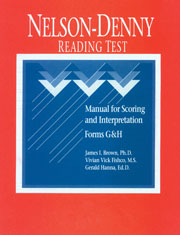
Nelson-Denny as a pre- and post test for a Basic Reading Class
For the past several semesters, I, along with reading faculty colleagues at Leeward Community College, have been using the Nelson-Denny as a pre- (Form G) and post-test (Form H) for the students enrolled in remedial and developmental reading courses. Some include the Nelson-Denny as part of the course grade, with points given to students who have demonstrated improvement from pre- to post-test.
What I have been doing is giving full credit (100%) on the post-test for students who score at the 8.5 grade level or higher. For those who test out at a lower grade level, they earn a lower percentage. For my classes (Eng 8 --Basic Reading and Writing), the Nelson-Denny (Form H) is worth 5% of the final grade for the class.
One question that may come to mind is Why grade level 8.5? What I can say is that in doing a search for the appropriate exit level for students in Eng 8, I found nothing conclusive. However, what I did find is that at least one instructor at another CC in the University of Hawaii system is using the Nelson-Denny score (grade level 10.5) as part of the exit criteria for his course, and this course (Eng 21) is two levels above Eng 8 (with Eng 18 being the course in between). So I surmised that 8.5 would be an appropriate grade level for exit from Eng 8, and 9.5 would be appropriate for Eng 18, and 10.5 for Eng 21.
Any comments? Suggestions?
Subscribe to:
Posts (Atom)